Vibe Shift: Rise of the Claw, Self-coding Agents, and The Future of Enterprise Software
Vibe Shift: Rise of the Claw, Self-coding Agents, and The Future of Enterprise Software
By
Ross
on •

The speed of change in the world of software, and AI Agents in particular, continues to increase at a dizzying pace. This past month OpenClaw, the next iteration of agents, became the fastest growing open source project the world has ever seen and introduced the concept of agents to a whole new group of people willing to run it on their local machines.
This may seem like a small thing for serious software built and run inside serious businesses, but it actually represents the beginnings of a sea change for both tech companies and enterprises alike.
Rise of the Claw
Claw-type agents, beginning with OpenClaw (formerly known as Clawdbot and momentarily known as Moltbot) are the latest in AI agents. For now only adventurous and computer savvy individuals are willing to incur the risk to reap the rewards. But faster than the iPhone made the leap from consumer to businesses, everyone will have one soon.
So what are they?
Claw-type agents are simply coding agents whose primary purpose is “vibe coding” (think: OpenAI’s Codex or Anthropic’s Claude Code) with a bunch of additional features and skills to do non-coding things.
The same loop (or “agent harness”) that allows these agents to be very effective at writing code turns out to also be very effective for all kinds of other tasks.
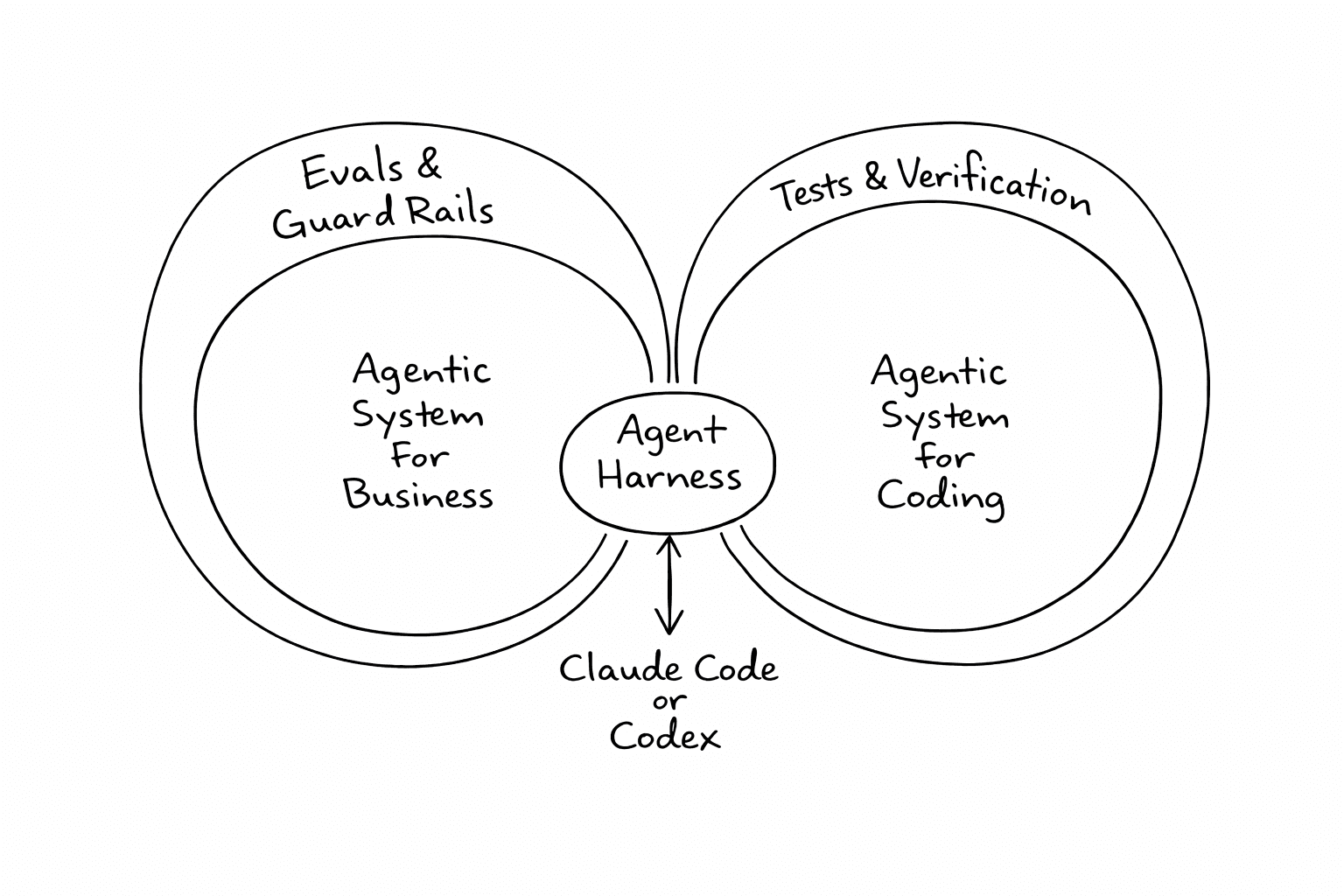
Simply take that fundamental loop, integrate it with other tools like messaging apps, email, calendar, salesforce, AWS, and pretty much any other service you can imagine, give it some guidelines and let it take autonomous action toward a goal.
A big part of the success is the user experience: once hooked up, the primary user is able to communicate with the agent via WhatsApp, Signal, or any other messaging app to give instructions and receive feedback.
This is far from the final form agents will take, but it represents a meaningful step in the right direction. Agents that have more autonomy, take more direct action, and generally have a lot more agency than the previous agentic frameworks allowed.
Given a goal, a set of skills, and a set of integrations, these agents will tirelessly pursue success and get surprisingly creative to solve whatever problem is put in front of them.
Self-coding Software
These agents have another massively important, and underreported, attribute that will change the world of software forever: the ability to actively write code that adds features to themselves.
If you’re a sci fi nerd like me (and who isn’t these days?) you’ll recognize this notion of computer programs that autonomously improve themselves as the beginnings of The Singularity. Portrayed here in Johnny Depp’s not-so-well-received-but-actually-kind-of-ok Transcendence:

Johnny Depp as a claw-type agent
The reality is (probably) much less dramatic, but still impactful for businesses looking to realize the potential within this loop of continuous self-improvement. Custom software and agents that build themselves to match perfectly with existing integrations and processes is a game changer for the cost to build and maintain as well as the value delivered for both traditional and agentic software.
Enterprise Starter Kit
How do you take advantage of this as an enterprise or medium sized business?
First, you’ll need to partner with a foundation model company. Specifically, you should be looking at one of OpenAI or Anthropic. These are the companies who, as of this writing, have the coding agents, foundation models, and engagement vehicles to make this possible inside the enterprise.
To be clear, this won’t work with Copilot, Cursor, Windsurf, etc. And it won’t work with the previous generation of foundation models. It’s a case of “you must be this tall to ride” in terms of model intelligence. Anything less than Anthropic’s Opus 4.5 or OpenAI’s GPT5.2 and you’re gonna have a bad time.
Also to be clear, you should not even think about installing OpenClaw inside the enterprise in its current form. That’s a security nightmare for any enterprise. Open source claw-type agents in general carry security risk as they’re a tempting target for supply chain and other attacks.
The good news is the core of claw-type agents is relatively simple and can be recreated with the raw materials from the above-mentioned foundation model partners in ways that meet enterprise security needs.
To do this is in a safe and secure fashion, you’ll need a team of AI Engineers capable of two things:
Building agents with a safety net of security, reliability and human-in-the-loop constraints wrapped around them.
Building agents that have both the ability to self-code and, more importantly, the ability to verify the code they produce.
The software you build now should be built to build itself. And you should make that explicit: a literal set of features on your roadmap and in the backlog, which ultimately becomes code and configuration checked into the repository of your codebase.
For now humans are very much in the loop of both #1 and #2. #1 is achieved through re-ingesting generated data to create a safety net of evals, guard rails, and filters which keep the agent on track. #2 is achieved through iteration by real live human software developers incrementally configuring a coding agent to effectively generate and verify reliable code within that codebase.
Build is the New Buy
Formerly, the time, cost and energy to build custom internal software meant that, in the build vs. buy equation, “buy” was the right answer for almost anything not offering a significant strategic advantage to the business.
This new development changes that equation in a few different ways.
First, and most obvious, is that the time and cost of building and maintaining custom software is dropping dramatically. Smaller teams of developers are able to build much more software much more quickly. And, if they know what they’re doing, maintain the same level of quality and agility they could in the days of hand-coding.
Second, the speed of innovation is dramatically increasing. Buying a static SaaS or platform product, especially AI agents or an agentic platform, risks locking yourself into something that will become out of date quickly.
Third, SaaS and platforms are large static codebases containing the superset of every feature for every customer out there. The companies who build those platforms spend time and energy on building and maintaining those features for other customers who are not you. That means that the moment you procure this software, you’re likely falling behind the bleeding edge.
Finally, strong AI Agents that operate inline with your internal business practices ARE a competitive advantage. Speed and efficiency represent a vector for winning inside of your vertical, and AI Agents built to seamlessly integrate into your existing business process are a direct path to achieving that.
Compounding Returns
A new breed of agent is here. One that is both an agentic coder and an agentic employee at the same time. This is a big opportunity for enterprise businesses and changes the equation in any software procurement conversation; especially any AI-related procurement conversation.
The returns on implementing this type of agent are unique in their ability to compound – leading directly to compounding returns in the business as well.
I want to emphasize that this is not easy. It’s only achievable by humans with years of experience in software development and applied AI. There’s an ocean of hype out there telling you this is easy if you use xyz framework, sandbox, SaaS, or platform.
I’m here to tell you the hard truth: there is no easy button. This technology is brand new, and the rewards for those who move quickly are huge, but there is no buying it in a pretty wrapped box. For now, there is only building it as a custom agentic software system which generates data that fuels reliability and improvement of the system itself.
A beautiful evolutionary loop of compounding self-improvement.
Acknowledgements:
Thanks to Adam Pritzker for the title and to Mike McCormick for editorial.
No LLMs were used in the production of this work.
The speed of change in the world of software, and AI Agents in particular, continues to increase at a dizzying pace. This past month OpenClaw, the next iteration of agents, became the fastest growing open source project the world has ever seen and introduced the concept of agents to a whole new group of people willing to run it on their local machines.
This may seem like a small thing for serious software built and run inside serious businesses, but it actually represents the beginnings of a sea change for both tech companies and enterprises alike.
Rise of the Claw
Claw-type agents, beginning with OpenClaw (formerly known as Clawdbot and momentarily known as Moltbot) are the latest in AI agents. For now only adventurous and computer savvy individuals are willing to incur the risk to reap the rewards. But faster than the iPhone made the leap from consumer to businesses, everyone will have one soon.
So what are they?
Claw-type agents are simply coding agents whose primary purpose is “vibe coding” (think: OpenAI’s Codex or Anthropic’s Claude Code) with a bunch of additional features and skills to do non-coding things.
The same loop (or “agent harness”) that allows these agents to be very effective at writing code turns out to also be very effective for all kinds of other tasks.
Simply take that fundamental loop, integrate it with other tools like messaging apps, email, calendar, salesforce, AWS, and pretty much any other service you can imagine, give it some guidelines and let it take autonomous action toward a goal.
A big part of the success is the user experience: once hooked up, the primary user is able to communicate with the agent via WhatsApp, Signal, or any other messaging app to give instructions and receive feedback.
This is far from the final form agents will take, but it represents a meaningful step in the right direction. Agents that have more autonomy, take more direct action, and generally have a lot more agency than the previous agentic frameworks allowed.
Given a goal, a set of skills, and a set of integrations, these agents will tirelessly pursue success and get surprisingly creative to solve whatever problem is put in front of them.
Self-coding Software
These agents have another massively important, and underreported, attribute that will change the world of software forever: the ability to actively write code that adds features to themselves.
If you’re a sci fi nerd like me (and who isn’t these days?) you’ll recognize this notion of computer programs that autonomously improve themselves as the beginnings of The Singularity. Portrayed here in Johnny Depp’s not-so-well-received-but-actually-kind-of-ok Transcendence:
Johnny Depp as a claw-type agent
The reality is (probably) much less dramatic, but still impactful for businesses looking to realize the potential within this loop of continuous self-improvement. Custom software and agents that build themselves to match perfectly with existing integrations and processes is a game changer for the cost to build and maintain as well as the value delivered for both traditional and agentic software.
Enterprise Starter Kit
How do you take advantage of this as an enterprise or medium sized business?
First, you’ll need to partner with a foundation model company. Specifically, you should be looking at one of OpenAI or Anthropic. These are the companies who, as of this writing, have the coding agents, foundation models, and engagement vehicles to make this possible inside the enterprise.
To be clear, this won’t work with Copilot, Cursor, Windsurf, etc. And it won’t work with the previous generation of foundation models. It’s a case of “you must be this tall to ride” in terms of model intelligence. Anything less than Anthropic’s Opus 4.5 or OpenAI’s GPT5.2 and you’re gonna have a bad time.
Also to be clear, you should not even think about installing OpenClaw inside the enterprise in its current form. That’s a security nightmare for any enterprise. Open source claw-type agents in general carry security risk as they’re a tempting target for supply chain and other attacks.
The good news is the core of claw-type agents is relatively simple and can be recreated with the raw materials from the above-mentioned foundation model partners in ways that meet enterprise security needs.
To do this is in a safe and secure fashion, you’ll need a team of AI Engineers capable of two things:
Building agents with a safety net of security, reliability and human-in-the-loop constraints wrapped around them.
Building agents that have both the ability to self-code and, more importantly, the ability to verify the code they produce.
The software you build now should be built to build itself. And you should make that explicit: a literal set of features on your roadmap and in the backlog, which ultimately becomes code and configuration checked into the repository of your codebase.
For now humans are very much in the loop of both #1 and #2. #1 is achieved through re-ingesting generated data to create a safety net of evals, guard rails, and filters which keep the agent on track. #2 is achieved through iteration by real live human software developers incrementally configuring a coding agent to effectively generate and verify reliable code within that codebase.
Build is the New Buy
Formerly, the time, cost and energy to build custom internal software meant that, in the build vs. buy equation, “buy” was the right answer for almost anything not offering a significant strategic advantage to the business.
This new development changes that equation in a few different ways.
First, and most obvious, is that the time and cost of building and maintaining custom software is dropping dramatically. Smaller teams of developers are able to build much more software much more quickly. And, if they know what they’re doing, maintain the same level of quality and agility they could in the days of hand-coding.
Second, the speed of innovation is dramatically increasing. Buying a static SaaS or platform product, especially AI agents or an agentic platform, risks locking yourself into something that will become out of date quickly.
Third, SaaS and platforms are large static codebases containing the superset of every feature for every customer out there. The companies who build those platforms spend time and energy on building and maintaining those features for other customers who are not you. That means that the moment you procure this software, you’re likely falling behind the bleeding edge.
Finally, strong AI Agents that operate inline with your internal business practices ARE a competitive advantage. Speed and efficiency represent a vector for winning inside of your vertical, and AI Agents built to seamlessly integrate into your existing business process are a direct path to achieving that.
Compounding Returns
A new breed of agent is here. One that is both an agentic coder and an agentic employee at the same time. This is a big opportunity for enterprise businesses and changes the equation in any software procurement conversation; especially any AI-related procurement conversation.
The returns on implementing this type of agent are unique in their ability to compound – leading directly to compounding returns in the business as well.
I want to emphasize that this is not easy. It’s only achievable by humans with years of experience in software development and applied AI. There’s an ocean of hype out there telling you this is easy if you use xyz framework, sandbox, SaaS, or platform.
I’m here to tell you the hard truth: there is no easy button. This technology is brand new, and the rewards for those who move quickly are huge, but there is no buying it in a pretty wrapped box. For now, there is only building it as a custom agentic software system which generates data that fuels reliability and improvement of the system itself.
A beautiful evolutionary loop of compounding self-improvement.
Acknowledgements:
Thanks to Adam Pritzker for the title and to Mike McCormick for editorial.
No LLMs were used in the production of this work.
© 2026 Artium